
AC Not Cooling? A 10-Minute Diagnosis Checklist Before You Call Anyone
Half of the “not cooling” calls we attend are solved by a filter wash or a tripped isolator. Run this checklist first and your call will be shorter, cheaper and more accurate.
A warm room is a symptom with a dozen causes, and only two of them involve refrigerant. Because a technician visit costs money either way, ten minutes of checking at home is worth doing before you book. This is the same sequence our team runs on arrival — nothing here requires tools beyond a torch and a thermometer if you have one.
Step 1: confirm the unit is actually running
Listen and look before anything else. Is the indoor blower blowing at all? Is the outdoor fan spinning? Is the outdoor compressor making its low hum, or is it silent while the fan turns?
Three combinations tell you a lot:
- Indoor on, outdoor silent. Usually electrical — a tripped MCB, a failed capacitor, or a control signal not reaching the outdoor unit.
- Both running, no cooling. Airflow restriction, dirty condenser, or low refrigerant charge.
- Nothing running, display off. Power, remote batteries, or a blown indoor fuse.
Also check the remote: mode set to Cool (not Fan or Dry), temperature below room temperature, and the fan speed not on the lowest setting. We attend several calls a month where the unit was in Dry mode.
Step 2: wash the filters
Open the front flap, slide both filters out, and hold them up to a light. If you cannot see light through the mesh, they are the problem — or at least part of it. Rinse from the back under a tap, dry them in shade (not direct sun, which warps the frame), and refit.
Dirty filters reduce airflow across the coil, which reduces heat exchange, which makes the unit run longer at a higher current draw. A unit that cooled adequately last month and now does not is very often a filter issue, especially in flats near road dust or construction.
While the filters are out, look at the coil behind them. If you see a grey mat rather than finned metal, cleaning the coil — not just the filters — is the fix.
Step 3: check what is coming out of the louver
Hold your hand at the louver after five minutes of running.
| What you feel | What it usually means |
|---|---|
| Strong airflow, air not cold | Low gas, dirty outdoor condenser, or compressor not engaging |
| Weak airflow, air cold | Dirty filters, blocked evaporator coil, failing blower capacitor |
| Weak and not cold | Combination: airflow restriction plus refrigerant or compressor fault |
| Cold for 5 minutes, then warm | Compressor cutting out on overload — condenser blocked or gas pressure issue |
If you own an infrared thermometer, measure the return air at the filter and the supply air at the louver. A split that is working correctly should show roughly 8–12°C difference. Less than 6°C means something is wrong; more than 14°C usually means restricted airflow.
Step 4: inspect the outdoor unit
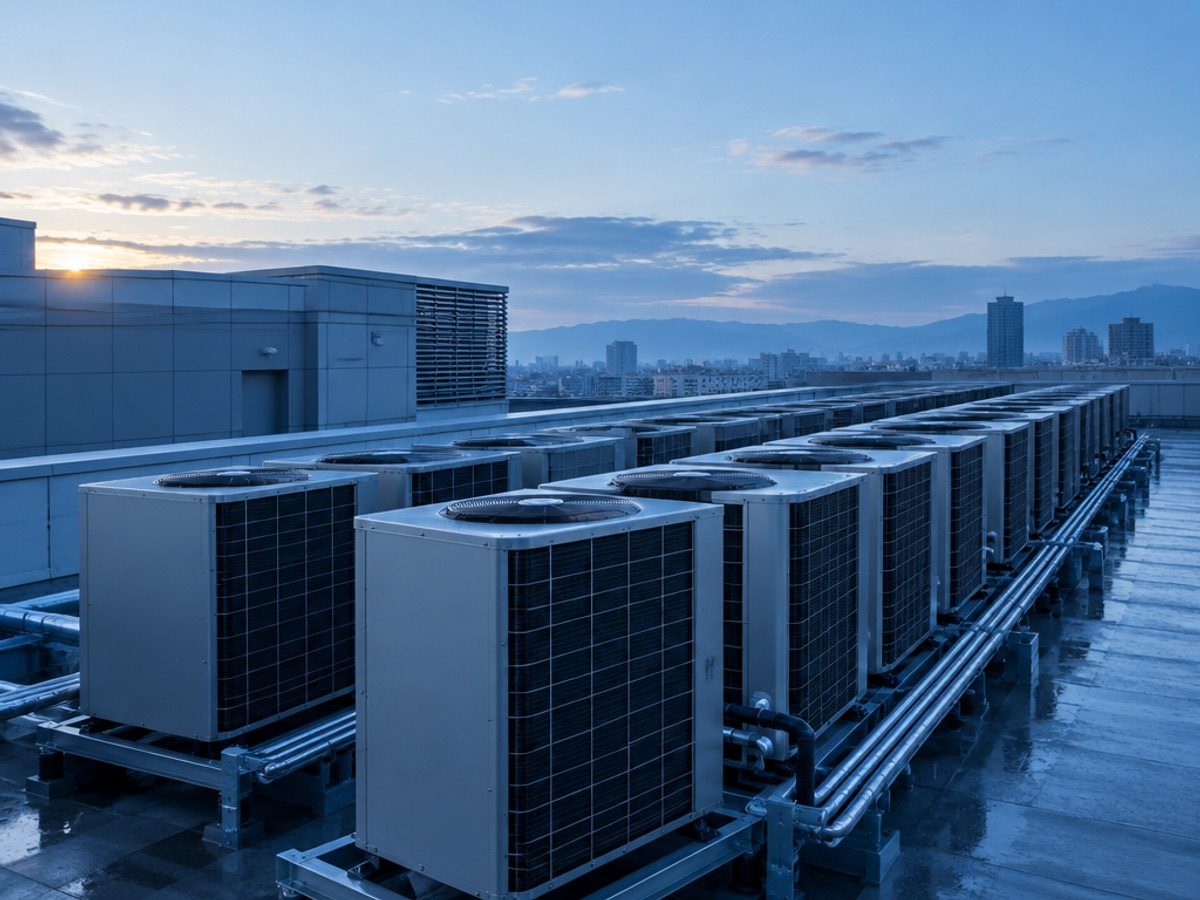
Stand where you can see the condenser. It should be clear of obstructions for at least half a metre, and the fins should be visible aluminium, not a grey felt of dust and leaf litter.
Three checks take a minute:
- Airflow direction. Hot air should be pushed away from the unit strongly. Weak discharge means a dirty coil or a failing fan capacitor.
- Fins. If they are clogged, no amount of indoor cleaning will restore cooling. Condenser cleaning is part of a proper service.
- Surroundings. A condenser boxed in by a balcony enclosure, laundry or storage recirculates its own hot air and will never cool well. This is common in Dombivli and Thane tower flats.
If the outdoor unit is on a bracket above the third floor, do not lean out to inspect it. Describe what you can see and let the technician handle it with the right access.
Step 5: note the pattern, not just the symptom
When exactly does cooling fail? The answer narrows the diagnosis sharply.
Fails after 10–20 minutes. Classic overload: the compressor cuts out on thermal protection. Causes are a blocked condenser, an overcharged system, or a failing capacitor. It will usually restart after a rest period — which is why it feels intermittent.
Fails at peak afternoon heat. Undersized unit or poor condenser ventilation. If it cools at night and not at 3 pm, the equipment is working at the edge of its capacity.
Fails only in humid weather. Often a drain or sensor issue rather than cooling itself; the unit may be shutting down on a water-full or anti-freeze protection.
Never cooled well since installation. Installation issue: undersized piping, poor vacuum before charging, or a unit sized for a smaller room.
Step 6: know what not to do
Some well-intentioned steps make things worse or cost money.
- Do not top up gas on a guess. Refrigerant does not get used up. If it is low, there is a leak and the gas will leave again.
- Do not spray water into the indoor unit without a service bag — you will soak the wall, the wiring box and possibly the PCB.
- Do not reset the MCB repeatedly if it trips. A tripping AC is an electrical fault and repeats can damage the compressor.
- Do not run a unit with ice on the indoor coil. Switch it off and call — ice means restricted airflow or low charge, and continued running stresses the compressor.
When you do call, give the unit type, tonnage, age, the exact pattern above, and whether the outdoor unit is accessible. That single message is enough for a technician to arrive with the right parts and gives you an accurate estimate before the visit.
Key takeaways
- Confirm the mode, filters and airflow before assuming a refrigerant fault.
- Strong but warm air points to condenser or charge; weak but cold points to airflow.
- A unit that cools then stops after 15 minutes is overheating, not low on gas.
- Clogged outdoor condenser fins will defeat any indoor cleaning.
- Never top up refrigerant without a pressure test and leak check.
Frequently asked questions
My AC runs but does not cool — is it always low gas?
No. Dirty filters, a clogged condenser, a failed capacitor or a compressor that will not engage all produce the same symptom. Pressure testing is the only way to confirm charge.
Can I use my AC if it is not cooling?
In fan mode it is harmless. In cool mode a unit with restricted airflow can ice up and stress the compressor, so it is better switched off until checked.
How long should an AC take to cool a room?
A correctly sized split should bring a bedroom down noticeably within 10–15 minutes. If it takes over half an hour, airflow, sizing or charge needs review.
Transparent pricing
Featured AC services and rates
Published rates straight from the AK Aircon Services rate card — 13 categories covering service, installation, gas charging, repair, parts and material.
| Service | Split AC | Window AC |
|---|---|---|
| Dry / Lite service | ₹399 | ₹399 |
| Standard jet service | ₹549 | ₹549 |
| Foam jet service | ₹649 | ₹649 |
| Deep dismantle service | ₹1,349 | — |
| Inspection / diagnosis visit | ₹299 | — |
| Gas charging | ₹2,499 | — |
| Leakage repair | ₹1,499 | — |
| Standard installation | ₹1,499 | ₹1,499 |
| Uninstallation | ₹899 | ₹899 |
| Indoor unit shifting | ₹1,299 | — |
| PCB / electrical repair | ₹1,799 | — |
| Compressor replacement | ₹6,499 | — |
| Copper pipe (per metre) | ₹550 | ₹550 |
Prices include labour and material unless a note states otherwise. Installation material is extra. Units above 2.2 tons are quoted individually.
Need a specific price?
Tell us the unit type and the service. We confirm the exact charge before work starts.
See all 13 categoriesRates are transcribed from the AK Aircon Services rate card. Charges for unusual site conditions or non-standard equipment are confirmed before work begins.